Musings of an Iraqi Brasenostril on Jihad: Jabhat al-Nusra and the Islamic State of Iraq and ash-Sham: Aleppo Area

NOTE: In addition to the recent column started by Phillip Smyth “Hizballah Cavalcade,” “Musings of an Iraqi Brasenostril on Jihad” is a new semi-regular column that Aymenn Jawad Al-Tamimi will be writing. This was borne out of his excellent guest posts. I hope his posts will be useful to all who read in better understanding and dissecting what is going on in Syria and beyond as it relates to global jihadis.  An archive of all of Aymenn’s posts can now be found here.

By Aymenn Jawad Al-Tamimi
The past week or so has seen a significant controversy erupt in jihadist circles over the relationship between an entity called the Islamic State of Iraq and ash-Sham (ISIS)- a merger of Islamic State of Iraq (ISI) and Jabhat al-Nusra (JAN) first proclaimed by ISI emir Abu Bakr al-Baghdadi in April- and JAN as headed by Abu Mohammed al-Jowlani.
First came a purported letter by Jowlani circulated to his followers, summarizing an alleged edict by Aymenn al-Zawahiri that denied responsibility for Baghdadi’s announcement of ISIS and accordingly called for the abolition of this name, and recognition that ISI and JAN have the separate spheres of Iraq and Syria respectively. The Zawahiri document then came to light only a couple of days later, obtained by al-Jazeera.
The supposed Jowlani letter and the alleged ruling by Zawahiri (NB: I have provided full translations with notes on both documents here and here) both emphasize the need for cooperation between ISI and JAN, and mutual respect for each other’s efforts of jihad. In short, the documents merely call for an end to the name of ISIS, and stress an ideal harmony that is thought to have existed prior to Baghdadi’s declaration of ISIS.
Whatever the truth behind these documents, a quick search on Twitter, Facebook, forums and the like will show that many jihadi activists and media groups are continuing to use the name of ISIS as if nothing has happened. Most notably, the newspaper ash-Sharq al-Awṣat claims to have obtained a document circulated by those under the banner of ISIS denying the authenticity of the Zawahiri letter (hat-tip: Charles Lister).
Whether or not the newspaper has an authentic ISIS document, there are understandable reasons why those favoring the brand of ISIS might be skeptical? Why, for example, did Zawahiri not simply discuss the issues in his purported letter in the video statement? Why also did Jowlani not issue his letter in the name of JAN’s media channel al-Manarah al-Bayḍā’, which in the letter he claims will return to full operation very soon?
There are of course reasonable counter-arguments to these objections, most notably if one posits the idea that Zawahiri- as the alleged letter from him suggests- wanted the naming controversy dealt with quietly on the ground and out of the site of media, hence the initial lack of discussion in jihadi circles on social media and forums.
Yet here I am not so much concerned with debating the authenticity of the documents as realities and perceptions on the ground. What is apparent from recent evidence is that ISIS is an active entity in the Aleppo area, going beyond mere tweets and Facebook statuses of jihadis. In media articles on the ISIS-JAN controversy, reporters like Basma Atassi and Mariam Karouny have drawn a dichotomy of foreign fighters versus native Syrians, whereby the majority of the former are said to have flocked under the banner of ISIS.
Certainly this paradigm of analysis makes sense in Aleppo, which has since last year seen a particularly strong concentration of foreign mujahideen relative to other areas. There are in fact other battalions in the wider area using the same al-Qa’ida banner as ISIS, such as the Katiba al-Muhajireen (KAM) led by Abu Omar al-Shishani and Majlis Shura al-Mujahideen (not to be confused with the Gaza/Sinai group).
Thus, this relatively recent photo of a Qatari mujahid in Aleppo could be a fighter aligned with any one of the aforementioned groups. However, it must be recognized that the boundaries between these groups is not at all clear-cut, rather analogous to the fact that Iranian proxy groups in Iraq can serve as mere fronts for one another. In this context, my friend Shami Witness rightly points out that Baghdadi had appointed Shishani as emir of Aleppo, Idlib and Lattakia.
The most recent wave of evidence for ISIS activities in the Aleppo area most prominently featured the circulation of a photo of ISIS insignia being used in the area. As far back as 18 May, the pro-ISIS channel ash-Sham reported that ISIS fighters had freed a number of prisoners from Aleppo central prison.
It would appear that ISIS in Aleppo has been conducting siege operations against the central prison for quite some time, for the Syrian Observatory on Human Rights reported on June 7 that ISIS fighters in coordination with Harakat Ahrar ash-Sham was targeting the central prison with machine-gun fire.
Meanwhile, the past few days has seen a surge in the number of Youtube videos uploaded by the Halab News Network (NB: not pro-ISIS, but simply providing footage of developments in the Aleppo area) allegedly showing ISIS operations.
For instance, here is a video from the Duwerineh district of Aleppo, purporting to show clashes between ISIS fighters and regime forces. Here are two other videos from the same area, allegedly showing ISIS men targeting regime forces with Grad-missiles.
Another area of operations for ISIS is the regime stronghold of Jabal Ma’ar (dubbed Jabal Shouihna in the video titles), which is also being targeted by other battalions like the Kata’ib Nur ad-Din az-Zinki (see Facebook page here). Thus, here is one video where ISIS purportedly targets a tank with a Malyutka missile.
Likewise, here is a video of the aftermath of ISIS bombardment of regime positions in the same area. Further, here is a video of ISIS fighters in the area firing at regime forces: and note in particular the presence of the ISIS flag on the Mazda car.
So what of the relation between ISIS and JAN in the Aleppo area? To be sure, there is certainly a JAN presence in Aleppo (e.g. see this recent photo from Halwaniya). To hear from the report by Basma Atassi in particular, there have been tensions in Aleppo over distribution of flour, as fighters aligned with ISIS did not recognize the committee headed by JAN and other battalions responsible for said distribution.
Thus, Atassi’s report implies that in Aleppo, ISIS and JAN are two separate entities, which contrasts with the situation in Raqqah Governorate where ISIS and JAN are more or less synonymous and interchangeable. In my view this separation in the Aleppo area is borne out with other evidence.
For example, recently a report emerged from Aleppo of a child who had been brutally slain, allegedly by Islamist rebels for apostasy. In response, JAN and ISIS issued separate statements disassociating themselves from the execution, with the JAN statement also bearing a stamp of the ‘Shari’a committee in Aleppo’ and ‘Jabhat al-Nusra.’
Here is a copy of the ISIS statement, bearing the familiar stamp of the group and lacking identification with any Shari’a committee in the city. This corroborates the idea of lack of recognition by ISIS of the already established Shari’a organizations in Aleppo.
Videos of ISIS rallies in Aleppo also add to this portrait of separation and a degree of animosity between ISIS and JAN in Aleppo. Here is one video of an ISIS rally in the Bab al-Hadid area, featuring a recital of al-Fātiḥa. In a similar vein, here is a video of an ISIS march through Tariq al-Bab. Here is another video of the same rally, featuring the nasheed ‘Labbayka Islam al-Butula’ (see translation on my website; it is popular with Hizb-ut-Tahrir in Syria too).
There are two things to note about these rallies. First, Jabhat al-Nusra flags are nowhere to be seen. Second, the demonstrations are entirely separate from those held elsewhere in Aleppo featuring FSA flags, giving a strong contrast with Raqqah where ISIS, JAN and FSA flags can be observed together in a rally united under one cause (see my Jihadology post on Raqqah, as well as this recent video).
All this evidence suggests that no concord of understanding has been reached between pro-ISIS demonstrators and those of different ideological inclinations, or even with JAN activists who are similarly al-Qa’ida-aligned.
In sum, whereas Raqqah showed how JAN and ISIS could generally be interchangeable, the case of Aleppo appears to provide strong indications that the two organizations are separate and at odds with each other, with ISIS containing a disproportionate number of foreign fighters who are more strongly concentrated in Aleppo than other parts of the country.
Indeed, nothing may be thought to encapsulate this issue of ISIS, foreign fighters and Aleppo better than this video of a Turkish fighter under the ISIS banner in Aleppo (Duwerineh). The Raqqah-Aleppo contrast illustrates just how fragmented both ISIS and JAN are.
In any event, so long as there is no clear, public statement by Zawahiri or any other figures involved in the naming controversy of ISIS and JAN, and bearing in mind the issue of inevitable personal rivalries among different rebel groups, the problems of ISIS-JAN tensions in rebel-held areas of Aleppo are likely to remain and grow, even if clashes with regime forces in the Aleppo area do not preclude military cooperation between ISIS and other battalions.
Aymenn Jawad Al-Tamimi is a Shillman-Ginsburg Fellow at the Middle East Forum and a student at Brasenose College, Oxford University. His website is https://www.aymennjawad.org. Follow on Twitter at @ajaltamimi

New article from Shaykh Ḥussayn bin Maḥmūd: "al-Quṣayr and the Battle of Destiny"

بسم الله الرحمن الرحيم

الحمد لله معزّ الإسلام والمسلمين ومذلّ الشرك والمشركين ، والصلاة والسلام على قائد المجاهدين وسيّد الأوّلين والآخرين وعلى آله وصحبه أجمعين ومن تبعهم بإحسان إلىيوم الدين ..
عند فتح الأطلس العربي والنظر في خارطة سورية لن يجد الباحث “مدينة القصير” على الخارطة لسبب بسيط ، وهو : أن هذه المدينة ليست بالحجم الذي يؤهلها لأن تكون ضمن المدن التي تعلّم في الخارطة ، فهي مدينة صغيرة ذات كثافة سكانية منخفضة نسبة للمدن السورية .. تقع القصير بين حمص والحدود اللبنانية الشمالية الشرقية وهي أقرب إلى الحدود اللبنانية منها إلى مدينة حمص ..إن الحدود المشتركة بين سوريا ولبنان كبيرة ، والمدن القريبة للحدود اللبنانية كثيرة ، فلماذا الإستماتة في الظفر بالقصير من قبل النصيرية ورافضة حزب حسن نصر !!
لعل من الأسباب أن القصير بعيدة كل البعد عن حدود فلسطين ، فتركيز القتال فيها يحفظ أمن يهود ويُبعد الخطر المحدق بهم من قبل المجاهدين الذين لا يريد اليهود أن يعتادوا القتال قرب حدود فلسطين ، فمصلحة يهود تقتضي إبعاد المجاهدين عن حدود فلسطين قدر المستطاع ، فابتعاد حسن نصر عن مركزه وثقله في الجنوب وخوض معركته في الشمال ما هو إلا للحفاظ على أمن يهود .. 
هناك أمرآخر تكلمت عنه بعض الصحف والقنوات الدولية ، وهو أن القصير مفتاح شمال غرب سوريا ، أو الساحل السوري الذي يطمع النصيرية إقامة دولة لهم فيها حال انتصار المجاهدين ، والحقيقة التي لا بد أن يعيها من قرأ التأريخ : أن النصيرية لم يكونوا ليطمعوا بهذا إن لم تكن هناك وعود غربية (فرنسية على وجه التحديد) بذلك ، فالفرنسيون تبنوا النصيرية منذ قرون وهم من أتى بهم لسدة الحكم في سوريا ، والنصيرية أحقر من أن يبنوا دولة في الشام دون مدد الغرب الصليبي وموافقة اليهود .. إذا كان هذا هو مخطط القوم فإن احتلال القصير تمهيد لمحاصرة مدينة حمص وريفها ..
سبب آخر يجعلهم يستميتون في احتلال القصير ، هو : الهزائم المتتالية للجيش النصيري في الشام والتي أدت إلى انهيار الروح المعنوية لأفراد هذا الجيش ، فتضخيم معركة القصير وإحراز تقدم فيها يعد بمثابة طوق نجاة للحالة المعنوية المتردية لجنود النصيرية ، وبعد تورّط حسن نصر وإرسال جنوده إلى سوريا وتكبده خسائر كبيرة في الأرواح وحدوث انشقاقات في حزبه وأصوات تنادي بعودة جنوده أراد هذا الأخير أن يحرز أي نصر في الشام حتى يخرج من هذه الهوة التي سقط فيها ، ولذلك ألقى بأكثر ثقله في القصير ظناً منه أنها معركة سهلة كون المدينة صغيرة وقريبة من لبنان وليس فيها كثافة سكانية عالية ..
وربما أراد النصيرية والرافضة الحد من شدة ضربات المجاهدين في دمشق وحلب وبقية المدن الكبرى بإشغالهم بمدينة بعيدة نسبياً عن هذه الجبهات ، فالتهديد بمجزرة في القصير كفيلة بجلب انتباه الفصائل المجاهدة وخلط أوراقها وسحب بعض جنودها من الجبهات لاستنقاذ المسلمين في هذه المدينة ، وهذا ما حصل فعلاً ..
ماذا تعني القصير بالنسبة للمجاهدين ؟
الحقيقة أن القصير معركة معنوية أكثر منها معركة استراتيجية أو حتى تكتيكية ، وما يهم المجاهدين هو إخراج سكان القصير المسلمين منها والحفاظ على حياتهم ، فهذه المدينة لا تعني شيئاً من الناحية العسكرية أكثر من كونها رفع للروح المعنوية للروافض والنصيرية ، ولعل إدراك المجاهدين لهذا الأمر جعلهم يستبسلون في الدفاع عنها ليحرموا النصيرية هذه الروح ولينكوا فيهم ويكبدوهم خسائر في الأنفس والعتاد .. 
إن هذا القصف المتواصل والكبير لمدينة القصير كفيل بإسقاط المدن الكبيرة – بل وبعض الدول -في يد المعتدي ، ولكن المجاهدون ضربوا للعالم أمثلة رائعة في الصمود والتضحية لاستنقاذ النساء والأطفال في مدينة تهطل عليها الصواريخ كالمطر ، ويحاصرها الأعداء كالطوق ، وتدكها المدافع من كل الإتجاهات تضرب كل شيء دون تمييز ، ومع ذلك استطاع المجاهدون إخراج الكثير من سكان المدينة ، وبقي بعضهم ليحرموا عدوهم حتى من الفرحة المزيّفة ، وهذا ما لم نسمع به في تأريخ المعارك ، إلا القليل ..
تتجلى آيات الله تعالى في معركة القصير ، فهي معركة استدراج لأعداء الله أكثر منها معركة استنزاف للمجاهدين ، وهناك الكثير من المصالح التي سيجنيها المجاهدون من هذه المعركة التي هي وبال على أعدائهم من حيث لا يشعرون ، وهذا مصداق قول الله تعالى {وَيَمْكُرُونَ وَيَمْكُرُ اللهُ وَاللَّهُ خَيْرُ الْمَاكِرِينَ} (الأنفال : 30) ، وسيرى المسلمون نتيجة هذه المعركة رأي العين في الأيام القادمة بإذن الله ، ولولا خشية اطّلاع أعداء الله على هذه الكلمات لذكرت بعض المصالح المترتبة من هذه المعركة ، والتي أعمى الله عنها أعين أعداءه ..
لعله من المناسب توجيه بعض الكلمات لإخواننا المجاهدين في سوريا يستأنسون بها ويرون ما يصلح فيأخذوا به ، وهذا من باب أداء بعض الواجب الذي لهم علينا : 
1- لقد أجمع أهل العلم قاطبة على كفر النصيرية وردتهم عن الدين ، فمالهم ودمهم وذراريهم حلال للمسلمين ، فاقتلوا رجالهم واسبوا نسائهم وذراريهم ، فكل ذلك حل لكم ابتداءً ..
2- لا تمنعكم حدود اصطنعها عدوكم أن تنالوا من عدوكم اللبناني في عقر داره ، فالدار دار حرب ، فلا تكن بيوت المسلمين هي المهدمة فقط ، ولا أبنائهم هم المقصوفون فقط ، والله تعالى يقول {وَإِنْ عَاقَبْتُمْ فَعَاقِبُوا بِمِثْلِ مَا عُوقِبْتُمْ بِهِ} النحل : 126) ، فمن قتل أطفالكم جاز لكم قتل أطفاله ، ومن هدم بيوتكم جاز لكم هدم بيته ، وأيما جماعة ذات شوكة استحلت

New statement from Jabhat al-Nuṣrah in Wilāyat Dara’ā: "The Beginning of Operations to Liberate the Checkpoints al-Banāyyāt and al-Khazān in the Dara’ā Region of the Country"

VH641

بسم الله الرحمن الرحيم
بيان صادر عن المجلس العسكري في جبهة النصرة ( ولاية درعا ) (قاتلوهم يعذبهم الله بأيديكم ويخزهم وينصركم عليهم ويشفي صدور قوم مؤمنين ) ثأراً لإخواننا وأخواتنا ونصرة لهم ولأهل السنة، قام إخوانكم في جبهة النصرة بالتعاون مع لواء الحرمين التابع لحركة أحرار الشام الإسلامية ، لواء القادسية الإسلامي ، حركة المثنى الإسلامية ، ببدء معركة تحرير ( حاجز البنايات ) و ( حاجز الخزان ) في منطقة درعا البلد ، ومازالت المعركة مستمرة حتى الآن، ونقول لأهلنا في درعا خاصة وفي الشام عامة، أن دماءنا قبل دمائكم وأبناءنا قبل أبنائكم وأموالنا قبل أموالكم ، الدم الدم والهدم الهدم ، وبهذا نتوعد كل من يعتدي على أهل السنة بهذا المآل . ( ولله العزة ولرسوله وللمؤمنين ) المجلس العسكري في جبهة النصرة ( ولاية درعا )
يوم الخميس 6/6/2013

___________

To inquire about a translation for this statement for a fee email: [email protected]

As-Saḥāb Media presents a new video message from Dr. Ayman al-Ẓawāhirī: "Sixty-Five Years Since the Establishment of the Occupation State Israel"

GUEST POST: Jabhat al-Nusra and the Islamic State of Iraq and ash-Sham: Raqqah Governorate

NOTE: As with all guest posts, the opinions expressed below are those of the guest author and they do not necessarily represent the views of this blogs administrator and does not at all represent his employer at the Washington Institute for Near East Policy.
Jihadology.net aims to not only provide primary sources for researchers and occasional analysis of them, but also to allow other young and upcoming students as well as established academics or policy wonks to contribute original analysis on issues related to jihadism. If you would like to contribute a piece, please email your idea/post to azelin [at] jihadology [dot] net.
Past Guest Posts:
Hazim Fouad, “Salafi-Jihadists and non-jihadist Salafists in Egypt – A case study about politics and methodology (manhaj),” April 30, 2013.
Daveed Gartenstein-Ross and Tara Vassefi, “Perceptions of the “Arab Spring” Within the Salafi-Jihadi Movement,” November 19, 2012.
Jack Roche, “The Indonesian Jamā’ah Islāmiyyah’s Constitution (PUPJI),” November 14, 2012.
Kévin Jackson, “The Pledge of Allegiance and its Implications,” July 27, 2012.
Behnam Said, “A Brief Look at the History and Power of Anasheed in Jihadist Culture,” May 31, 2012.
Jonah Ondieki and Jake Zenn, “Gaidi Mtaani,” April 24, 2012.
Joshua Foust, “Jihadi Ideology Is Not As Important As We Think,” January 25, 2011.
Charles Cameron, “Hitting the Blind-Spot- A Review of Jean-Pierre Filiu’s “Apocalypse in Islam,” January 24, 2011.
Daveed Gartenstein-Ross, “Why Jihadi Ideology Matters,” January 21, 2011.
Joshua Foust, “Some Inchoate Thoughts on Ideology,” January 19, 2011.
Marissa Allison, “Militants Seize Mecca: Juhaymān al ‘Utaybī and the Siege of the Grand Mosque in Mecca,” June 9, 2010.

By Aymenn Jawad Al-Tamimi
A couple of weeks ago I wrote on emerging signs of an apparent split in some respects between Jabhat al-Nusra (JAN) and the Islamic State of Iraq and ash-Sham (ISIS). What other evidence has emerged since then? Here I will just focus on the rebel-held city of Raqqah and the wider Raqqah Governorate.
For one thing, the nature of the channel ‘ash-Sham’, which has put out a number of videos purportedly showing members of ISIS, has now become clear. While its now-terminated Youtube profile gave the impression that ash-Sham is run by someone in the United States, the channel is actually based in the city of Raqqah.
Here is an advertisement board put out by ash-Sham in Raqqah, with the slogan ‘Together, let us spread our Shari’a.’ In effect, the channel is a media front for ISIS in Raqqah, and so ash-Sham’s Facebook page also uploaded a photo of the entrance to ISIS’s security office in Raqqah, together with a view of the interior of the office.
More generally, the presence of ISIS supporters can be observed in videos of rallies in Raqqah. For instance, in this video clip of a 24 May demonstration for Qusayr in Raqqah, an ISIS banner can be seen, though it should also be noted that some of the protestors are also waving JAN flags, alongside others who hold FSA flags and one demonstrator for Harakat Ahrar ash-Sham al-Islamiya (HASI), which was the main group of rebel battalions that took over Raqqah in March.
Here is another video clip of protests in Raqqah on that day, again featuring an ISIS banner alongside an ISIS flag, together with HASI and FSA banners.  Note also this photo of one of the processions in solidarity with Qusayr with two ISIS flags in the background.
Further, on 31 May, a Friday protest was held in Sayf ad-Dawla street under the name of ‘Our Red Lines’ (alluding to the Obama administration’s shifting of the ‘red line’ on the use of chemical weapons in Syria). Here too one can observe an ISIS flag alongside FSA flags and white banners with the Shahada in black, signifying the realm of Islamic law.
Some inferences can be drawn here. First, whatever ideological differences the protestors and activists in Raqqah may have (and as I have noted before, there is a secular and anti-sectarian trend in the city), cooperation and accommodation rather than mutual hostility remain the norm at demonstrations, particularly those organized around common causes like solidarity with the rebels in Qusayr.
True, some activists in Raqqah have also protested against the rise in Shari’a courts, but to the extent that ISIS and other groups compete to win the support of locals, the competition for ‘hearts and minds’ is generally being pursued peacefully.
The second point to note is that the presence of JAN flags alongside ISIS symbols at demonstrations illustrates that posing an antagonistic JAN-ISIS dichotomy can be simplistic. Some of the activists aligned with ISIS and JAN may simply view each other’s names and banners as mere synonyms.
In a similar vein to JAN’s distribution of works by the likes of Abd al-Wahhab I have noted previously, ISIS is also offering study circles for the Qur’an and life of the Prophet at various mosques. Further, now that the presence in Raqqah has been established for some time, ISIS has taken upon itself to exercise jurisdiction over perceived criminals and regime agents.
The latter was shown with the widely-circulated execution video last month of three men accused of being officers in Assad’s forces, while an example of the former has recently come to light with ISIS’s arrest of a man identified as ‘Ahmad al-Assaf’, accused by ISIS of leading a gang responsible for stealing motorcycles and cars in Raqqah.
One further point suggesting continuity between ISIS and JAN in the Raqqah area and a relationship more or less along the lines of seeing the two there as synonymous is the issue of the northern border town of Tel Abyad. This town was the site of clashes between the northern Farouq Battalions and JAN at the end of March, most likely over control of border access points and resources.
Renewed clashes appear to have emerged in Tel Abyad at the end of May, only this time between Farouq (or the recently formed Liwaa Mustafa) and ISIS, with the latter then taking the initiative to distribute a notice with the ISIS insignia to residents on their right to report on and complain about misconduct by any of the mujahideen.
In short, the case of the city of Raqqah and the surrounding area is indicative of the complexity on the ground of the relationship between JAN and ISIS. In some places elsewhere in Syria, there is probably antagonism between those adopting the JAN label and others the ISIS symbols, but the picture in Raqqah and Raqqah governorate is one of continuity between ISIS and JAN.
Most importantly, the modus operandi of those identifying as ISIS- increasingly prevalent in Raqqah city rather than the banner of JAN- is not fundamentally different from JAN. Ultimately, it is ISIS’ actions on the ground that matter more than a name and flag.
Thus, I do not see a gradual shift to ISIS from JAN in the Raqqah area as having a significant impact for fighters and activists in sympathy with al-Qa’ida. Deeds- and not symbols or names- will decide their fortunes.
Aymenn Jawad Al-Tamimi is a Shillman-Ginsburg Fellow at the Middle East Forum and a student at Brasenose College, Oxford University. His website is https://www.aymennjawad.org. Follow on Twitter at @ajaltamimi

Ibn Taymīyyah Center for Media presents a new article from Abū Sulaymān al-Filisṭīnī: "Strength of the Field Officer and Repeating the Experience of 'Ḥizb Allah' in the Protection of the Jews"

BRTPa
Click the following link for a safe PDF copy: Abū Sulaymān al-Filisṭīnī — “Strength of the Field Officer and Repeating the Experience of ‘Ḥizb Allah’ in the Protection of the Jews”
__________

To inquire about a translation for this article for a fee email: [email protected]

Hizballah Cavalcade: Kata’ib Sayyid al-Shuhada: Another Supplier of Iraqi Shia Fighters in Syria

NOTE: For prior parts in the Hizballah Cavalcade series you can view an archive of it all here.

Kata’ib Sayyid al-Shuhada: Another Supplier of Iraqi Shia Fighters in Syria
By Phillip Smyth
Click here for a PDF version of this post
Untitled187
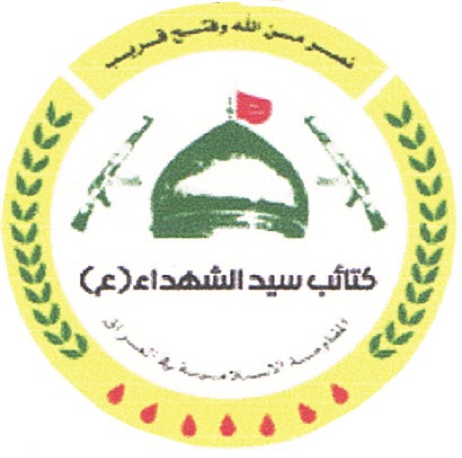
Figure 1: Kata’ib Sayyid al-Shuhada’s symbol.
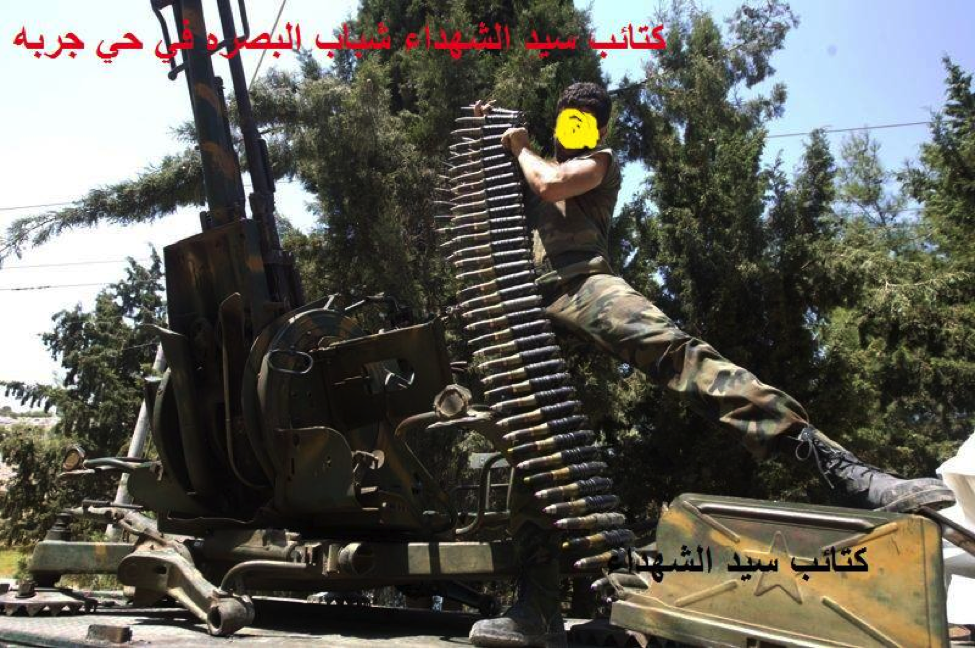
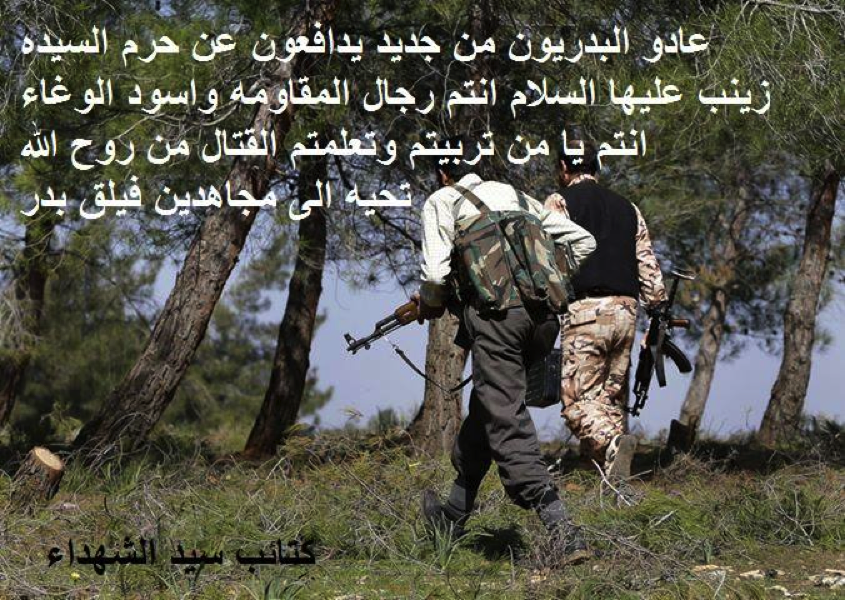
Following funerals for some of its members killed fighting in Syria, The Kata’ib Sayyid al-Shuhada (The Battalion of the Sayyid’s Martyrs or KSS) has quietly established itself as an Iraqi Shia militia force contributing combatants to the battlefront in southern Damascus. At present, the KSS’s main raison d’être appears to be as a source for Iraqi Shia fighters who can be used to “Defend the Zaynab Shrine”, a major Shia Islamic site in Syria.
The first reports of KSS’s existence occurred on April 14, 2013. In one press report, it was stated that KSS initially went by the names of Kata’ib Karbala (the Karbala Battalions) and later as Kata’ib Abu Fadl al-Abbas.[1] Interestingly, a group which had targeted American and Coalition forces in Iraq was and Iranian-backed “Special group” called Kata’ib Abu Fadl al-Abbas.[2] Adding further significance to the KSS’s earlier names and its links to Syria; KSS sends its fighters to Syria where they act as an intrinsic part of the Syrian-based Liwa’a Abu Fadl al-Abbas (LAFA).
It was reported that the KSS was formed due to splits within the Iranian-created and backed Kata’ib Hizballah.[3] These contentions were initially based on nameless sources and were reported by a small number of Iraqi Arabic-language publications.  It was also claimed that Abu Mustafa Sheibani (Hamid al-Sheibani), a pro-Iranian militia leader, who had been involved with the creation of many so-called “Special Groups” (including Asa’ib Ahl al-Haq and Kata’ib Hizballah) was KSS’s leader.[4] According to a Washington Institute for Near East Policy report, Sheibani “holds both Iranian and Iraqi citizenship” and when operating in Iraq, concentrated on the, “distribution of explosively formed penetrator (EFP) roadside bombs”.[5]
Based on the KSS’s few public appearances and its activity in Syria, it is likely the organization has a steady source of funding. Said funding allows the group to hold attention grabbing funerals and to put on airs of professionalism and organization. Nevertheless, based on Iraqi media, forums, and other social media sources, the size of the group’s membership, leadership, recruitment activities, and amounts of money it may receive remain unknown or unconfirmed.
Mirroring the activities of other Lebanese and Iraqi pro-Iranian groups, such as Kata’ib Hizballah, Asa’ib Ahl al-Haq, and Hizballah, the KSS sent a number of fighters to serve in the ranks of the Damascus-based Liwa’a Abu Fadl al-Abbas. When these fighters were killed, LAFA was often the initial or only group which would claim them as members. Only when Iraqi family members of dead fighters were interviewed, was it revealed their deceased relatives were also members of KSS.[6]
Pointing to direct Iranian support for KSS, the bodies of fighters who belonged to the organization have, on all occasions involving a funeral, been returned to Iraq via Iran. On May 6, 2013, the funeral for Diya Issawi included claims he belonged to KSS and that his body was returned to Iraq from Iran, through Basra.[7] Later that month, on May 17, 2013, two more funerals were held for Iraqis killed in Syria. The first, for Hassan Ali Farhud, was held in Sadr City, a Shia section of Baghdad.[8] The second funeral, for Muhammed Aboud al-Maliki, was held in Basra. Paralleling the return of Issawi’s body, Farhud and Maliki’s bodies were delivered through Iran. (Note: Partial profiles for Farhud, Issawi, and Maliki, were provided on Hizballah Cavalcade’s “Roundup of Iraqis Killed in Syria, Part 2”).
During funerals for its members, the KSS has fielded guards dressed in matching camouflage fatigues and a full color guard holding a mixture of KSS and Iraqi flags. Coffins for the dead are usually covered with Iraqi national (often painted onto the casket) and KSS flags. In most cases, the funeral processions resemble other funerals held for members belonging to Kata’ib Hizballah and Asa’ib Ahl al-Haq.
Untitled188
Figure 2: KSS statement released on May 8, 2013.
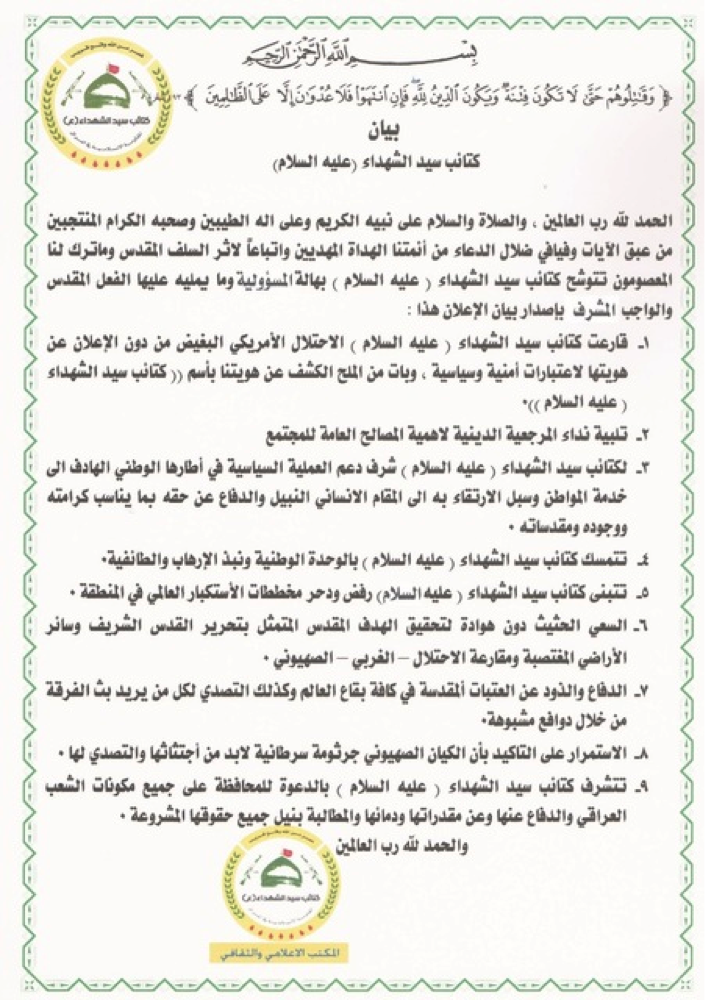
Following the funeral for Issawi, KSS declared its goals in a press statement issued by its media office. The group stated its aims included the protection of “shrines across the globe”, the preservation of “Iraqi unity”, and an end to sectarian conflict. It was claimed by KSS that its enemies were “Sowing [Islamic sectarian] discord” due to their “suspicious motives”. The group also mentioned that Israel is “Cancerous”, the U.S. occupation of Iraq was a symbol of “Arrogance”, and called for Jerusalem to be liberated.[9] For all intents and purposes, KSS repeated many of the main talking points presented by Lebanese Hizballah and Iran, albeit with an Iraqi spin.[10]
Despite the group’s statement claiming it was against sectarianism, some Iraqi forums reported the group had threatened to kidnap Iraqi Sunni Muslims.[11] Nevertheless, the KSS’s military activities appear to be limited to engagements in Syria.
WARNING: GRAPHIC IMAGES


Videos featuring KSS members have also been a relative rarity. Save for the posting of funeral videos made for fallen KSS members, only one video—posted on May 28, 2013—claims to be a KSS-specific combat video.  Released on YouTube, the film purports to show KSS members (likely attached to LAFA) operating in Syria and displaying the dead bodies of what the video refers to as, “Wahhabi Free Syrian Army mercenaries”. Further linking KSS to LAFA, the film was set to an Iraqi-made pro-Liwa’a Abu Fadl al-Abbas song, which first appeared online in early-2013. KSS members present in the film can also be seen wearing fatigues which are commonly worn by LAFA members.
When compared to LAFA and Lebanese Hizballah, social media and forum presence for Kata’ib Sayyid al-Shuhada has been sparse. What appeared to be a main Facebook “page” was created for the group on April 19, 2013.[12] However, the page conveyed little information and most posted material came on the day it was created or on April 26, 2013. The majority of the postings were of edited photos (mainly of the Zaynab Shrine) which could also be found on most pro-LAFA and pro-Hizballah websites. It is unknown whether the page was sanctioned by the group’s leadership. Membership for the page stands at fewer than 200. Additionally, a preponderance of those who “liked” the page lived in Baghdad, Iraq.
Facebook “Groups” have also been created for Kata’ib Sayyid al-Shuhada. Most of these groups have less than 300 members and tend to contain more information about the organization. Photos made specifically for KSS are present on these devoted KSS group pages. However, they tend to utilize imagery which has been used previously by LAFA. In general, KSS’s images are at times more amateurish than with other Shia militias operating in Syria.
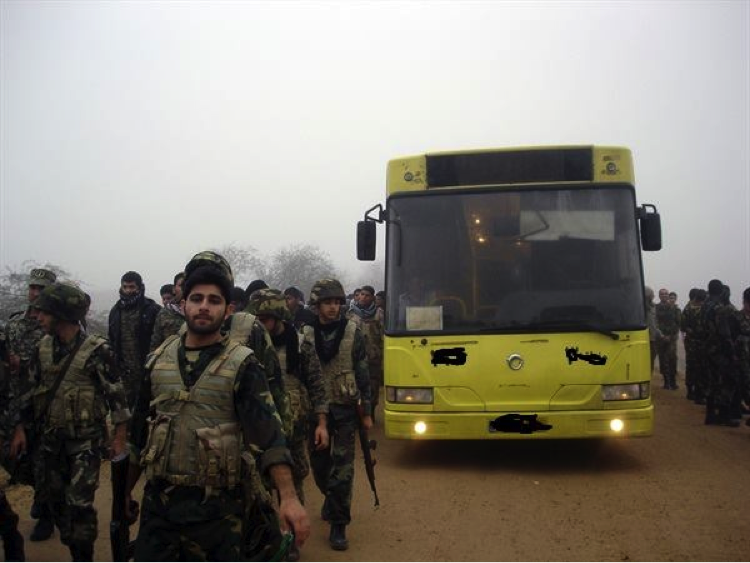
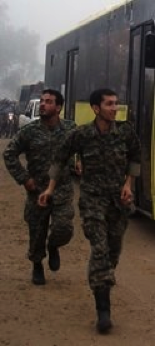
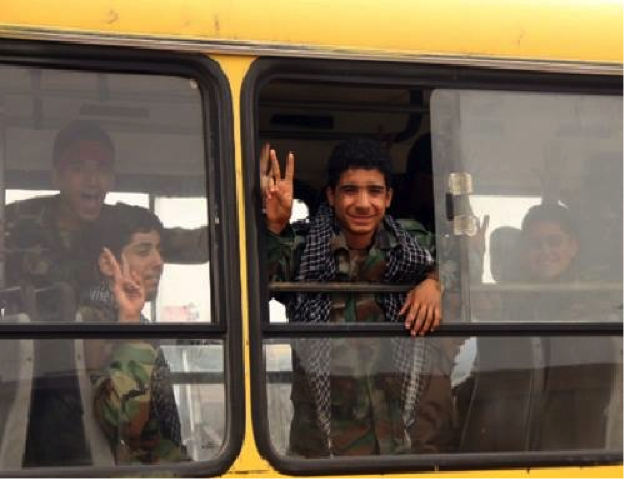
The KSS’s dead maintain positions of prominence in KSS Facebook groups. On rare occasions, photos of live KSS members serving with LAFA have their faces blurred. One KSS group page even featured photos of what were presumably KSS fighters arriving by bus to the frontlines in Syria. Based on the captions provided for these and other photographs, it appears that KSS fighters may primarily originate from Basra, Iraq. Incidentally, the many mentions of Basra would also coincide with two of the three funerals for killed KSS members, since they also occurred in Basra.
Untitled189 Untitled190 Untitled191 Untitled192 Untitled193 Untitled194
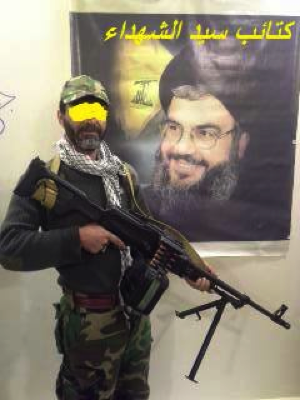
Figure 3: A KSS member is seen posing with a poster for Lebanese Hizballah leader Sayyid Hassan Nasrallah.
Underpinning the KSS’s Zaynab Shrine-centric role, their official symbol has a number of key images which emphasize Shi’ism, the Zaynab Shrine, and militarism. First, a stylized and green-colored image of Damascus’s Zaynab Shrine’s dome stands in the center with a red banner flying from the top. The raising of the red banner—symbolizing martyrdom and sacrifice—on top of the Zaynab Shrine has been used to great propagandistic effect by Shia groups such as Lebanese Hizballah and LAFA. The dome is flanked on two sides with images of AK-47 rifles. Around the dome on a roundel is a laurel wreath. At the bottom of the roundel are stylized blood drops. The blood drops may serve as a