For prior parts in this article series see: #3, #2, and #1.
—

___________
Source: Telegram
To inquire about a translation for this release for a fee email: [email protected]
For prior parts in this article series see: #3, #2, and #1.
—
___________
Source: Telegram
To inquire about a translation for this release for a fee email: [email protected]
Click here for the first issue.
—
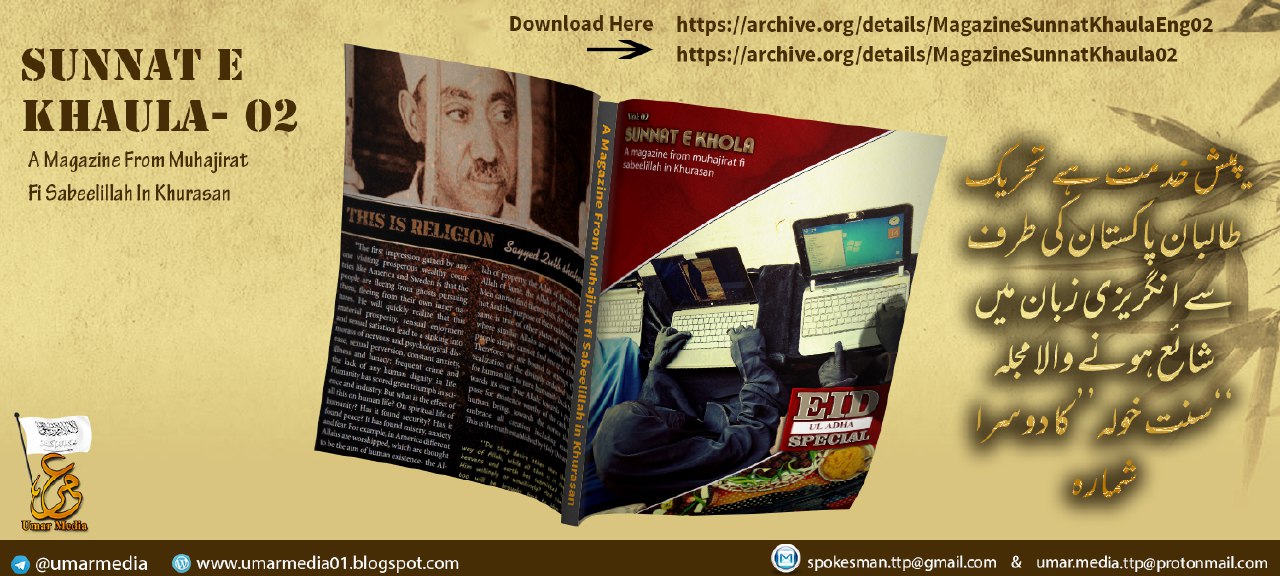
Click the following link for a safe PDF copy: Teḥrīk-ī-Ṭālibān Pākistān — Sunnat Khawlah Issue #2
___________
Click the following link for a safe PDF copy: Majlis Shūrā al-Mujāhidīn Darnah — The Martyr al-Ḥāj Ṣāliḥīn
____________
Source: Telegram
____________
To inquire about a translation for this video message for a fee email: [email protected]
For prior parts in this article series see: #2 and #1.
—
Click the following link for a safe PDF copy: Dr. Sāmī al ‘Uraydī — “Testimonies About Breaking Ties Between Jabhat al-Nuṣrah and al-Qā’idah #3
___________
To inquire about a translation for this release for a fee email: [email protected]
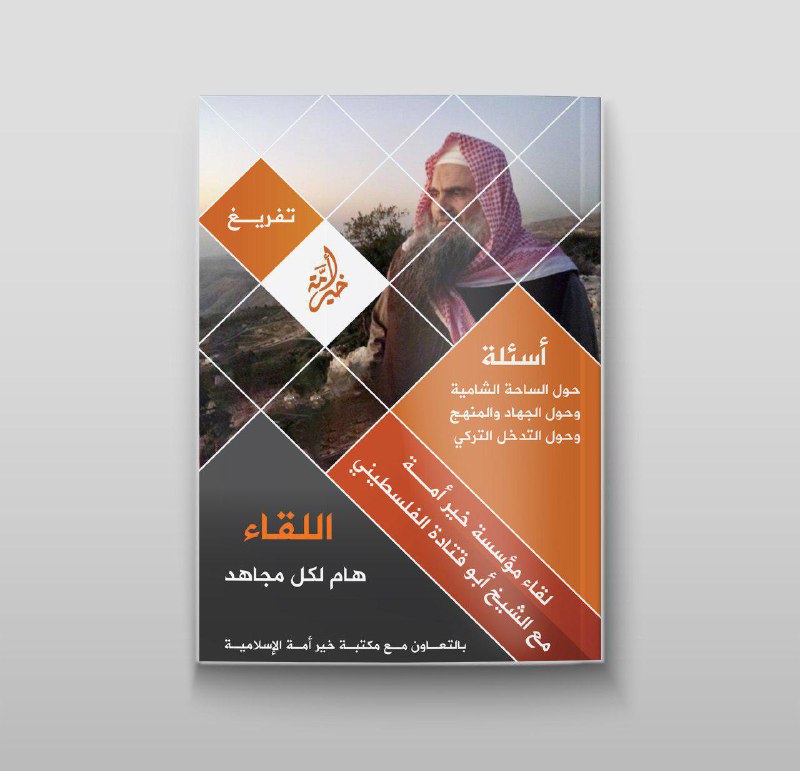
Click the following link for a safe PDF copy: Khayr Ummah Foundation — Meeting with Shaykh Abū Qatādah al-Filisṭīnī
__________
To inquire about a translation for this release for a fee email: [email protected]
Click here for the first part in this article series.
—
Click the following link for a safe PDF copy: Dr. Sāmī al ‘Uraydī — “Testimonies About Breaking Ties Between Jabhat al-Nuṣrah and al-Qā_idah #2
___________
To inquire about a translation for this release for a fee email: [email protected]
As with all guest posts, the opinions expressed below are those of the guest author and they do not necessarily represent the views of this websites administrator and does not at all represent his employer at the Washington Institute for Near East Policy.
Jihadology.net aims to not only provide primary sources for researchers and occasional analysis of them, but also to allow other young and upcoming students as well as established academics or policy researchers to contribute original analysis on issues related to jihadism. If you would like to contribute a piece, please email your idea/post to azelin [at] jihadology [dot] net.
Click here to see an archive of all guest posts.
—
—
Hymnal Propaganda: A Closer Look at ‘Clanging of the Swords’
Nashīds are a prime example of the Islamic State’s efforts to combine old and new rhetorical features to promote and legitimize its violent ends
By Alexander Schinis
Part of the Islamic State’s (IS) claim to fame is its high-value media productions. Some of its most popular productions are its hymns, or anashīd, which have spread around the world in the past years. The hymns serve as a rallying cry to their listeners, a call-to-arms on behalf of the terror group’s military goals. More than just overt calls for war, though, anashīd serve the group as foundational and legitimizing texts. Coded within the works of IS-produced anashīd are clues about its efforts to cast itself as the leader of global jihad.
This article will examine some of the structural features of one of IS’s most popular anashīd. In addition to these features, an assessment of the martial lyrical content of the nashīd will follow. Analyzing these features together will reveal some of IS’s many strategies in legitimizing itself as heir to leadership over the Islamic ummah.
What is a nashīd?
A nashīd (plural: anashīd) is a vocalized chant, frequently polyphonic and often without any instrumentation. There is significant variation across genres of anashīd. The work of Behnam Said includes some of the most comprehensive research into the history and cultural relevance of these types of works (Studies in Conflict and Terrorism, 2012).
The focus here is on the public-facing anashīd produced by IS. The qualities of these anashīd place the works somewhere between an exultant battle hymn and self-righteous national anthem.
One of IS’s most well-known anashīd, called “Clanging of the Swords,” offers a compelling example of what such a nashīd looks and sounds like. This nashīd was retrieved from www.archive.org. Aymenn al-Tamimi offers one version of the English translation, linked here. Featuring the vocals of the munshid Abu Yaser, the nashīd made its debut in the video propaganda production of the same name in the summer of 2014.
Repetition in the nashīd
It will not take long for the listener to recognize how repetitive “Clanging of the Swords” is. Repetition is an integral part of many of IS’s anashīd. However, this should not be read as a lack of creativity on the part of their creators. Instead, the nashīd presents itself as a medium that enjoys a strong relationship with memory. Charles Hirschkind, in a study of sermons and the practice of “ethical listening” in Egypt, found that sermons could be easily memorizable because of their use of repetition (Columbia University Press, 2006). He points to Marcel Jousse’s theory of gesture and memory, which states that gestures, such as aural patterns, are predisposed to easy memorization. The nashīd’s use of repetition is likely a strategy used by IS to facilitate their memorization by its intended audience.
Repetition in “Clanging of the Swords” appears on a few levels. The first is its repetition of the chorus, made up of four lines. The hymn repeats this chorus of four lines seven times – sometimes back-to-back – in the period of the hymn’s approximately three minute run time.
The second level of repetition in the anthem appears in an echo-like effect for certain lines, immediately after their utterance. The hymn has three discrete stanzas, all of which demonstrate this pattern, and the last line of each stanza is repeated. Taking into account the repetition of its chorus, in this scheme, 34 lines of verse are repeated at least once. Of the hymn’s total of 40 lines, only six lines do not find repetition in the hymn. This makes the non-repeated verses outliers in the verse repetition scheme of the nashīd.
The third level of repetition in “Clanging of the Swords” is the reiteration of a number of themes and words. This is partly a function of the two tiers of repetition noted above. Across the chorus and stanzas there are specific words that appear several times. If the subject of the hymn is the listener, the object is “the enemy.” The anthem invokes the word “enemy” or “enemies” (in Arabic, عدو \ أعداء) “oppressors” (in Arabic, الطغاة) or “aggressors” more than any other object in the work. Other recurring words and phrases that appear across lines and stanzas are ideas of a righteous “path,” the notion of “sacrifice,” and references to “God.”
The extensive and multi-layered use of repetition, when taking into account the theories of Hirshkind and Jousse, serves the political aims of IS’s cultural productions by lending the works to quick memorization by the listener.
Monorhyme in the nashīd
Structural repetition makes this and other anashīd catchy and quick to commit to memory, but other features lend the nashīd deeper significance to certain audiences. One such feature in “Clanging of the Swords” is the use of monorhyme, i.e., the rhyming of each line of verse with all other lines.
Each line of the hymn is made up of two hemistichs, and in the original Arabic of the hymn, the last vocalization of each line’s second hemistich rhymes with an “a” sound. This is achieved with a few different schemes. One includes rhyming different letters with similar sounds. This is seen in the chorus, where the use of the