The title of this video is in reference to two Qur’anic verses (9:11 and 33:5). Here they are in full: “But if they repent, establish prayer, and give zakah, then they are your brothers in religion; and We detail the verses for a people who know” (9:11) and “Call them by [the names of] their fathers; it is more just in the sight of Allah . But if you do not know their fathers – then they are [still] your brothers in religion and those entrusted to you. And there is no blame upon you for that in which you have erred but [only for] what your hearts intended. And ever is Allah Forgiving and Merciful” (33:5).
—

____________
To inquire about a translation for this video message for a fee email: [email protected]
Category: Syria
New statement from Jabhat al-Nuṣrah: "Official Position on Fighting the 'State' Group (Kharijites) in Eastern al-Qalimūn"

Click the following link for a safe PDF copy: Jabhat al-Nuṣrah — “Official Position on Fighting the ‘State’ Group (Kharijites) in Eastern al-Qalimūn”
_____________
To inquire about a translation for this statement for a fee email: [email protected]
New video message from Jabhat al-Nuṣrah: "Progress of the Battle in the Eastern Front for Eastern al-Ghūṭah and Liberating a Number of Points"

______________
To inquire about a translation for this video message for a fee email: [email protected]
GUEST POST: Abdullah al-Muheisini Weighs in on Killing of Alawite Women and Children
NOTE: As with all guest posts, the opinions expressed below are those of the guest author and they do not necessarily represent the views of this blogs administrator and does not at all represent his employer at the Washington Institute for Near East Policy.
Jihadology.net aims to not only provide primary sources for researchers and occasional analysis of them, but also to allow other young and upcoming students as well as established academics or policy wonks to contribute original analysis on issues related to jihadism. If you would like to contribute a piece, please email your idea/post to azelin [at] jihadology [dot] net.
Click here to see an archive of all guest posts.
—
Abdullah al-Muheisini Weighs in on Killing of Alawite Women and Children
By Sam Heller
With Syria’s advancing northern rebels poised to strike into heretofore safe regime strongholds in Lattakia and Hama, jihadist evangelist and fundraiser Abdullah al-Muheisini has weighed in on the permissibility of killing Alawite women and children via a ruling published on Twitter.
Syria’s northern rebels recently captured the city of Jisr al-Shughour, Idlib – a strategic crossroads in Syria’s northwest – and are now positioned to both consolidate their hold on this corner of the country and push further south and west into regime territory. This means that Alawite towns, including the coastal Alawite heartland, may now be in jeopardy. Though some of this talk is undoubtedly bluster, some rebels are now threatening to move on Alawite mountain villages in Lattakia, including the al-Assad family home of al-Qardaha. The head of the powerful Salafist militia Ahrar al-Sham Hisham “Abu Jaber” al-Sheikh, for example, has expressed the hope that the “wave of purification” that swept the “filth” from Jisr al-Shughour reaches “the mountains of the Nuseiriyyah [derog., Alawites].”
In anticipation of rebels’ capture of Alawite or mixed areas, al-Muheisini has ruled that it is generally impermissible to kill Alawite women and children. (Al-Muheisini’s tweets are translated below.) He argues against those pushing for rebels to respond to the regime’s mass murder of Sunni women and children in kind. He says that the religiously sanctioned principle of reciprocity or response in kind does not allow rebels to kill women and children, which is forbidden and which the Prophet Muhammad was himself known to discourage. He also rules against killing Alawite women and children as a deterrent to the regime, saying that the regime doesn’t care about Alawite civilians and that this “will only increase the regime’s criminality and barbarity.”
Yet taken as a whole, al-Muheisini’s verdict should not be considered encouraging, particularly when considered with the coda of tweets he added immediately after (also translated below). In the main ruling, for example, he does not rule out captured Alawite women’s subsequent execution for apostasy. Nor does he rule out the killing of women and children who bear arms, the justification with which Ahrar al-Sham argued against Human Rights Watch’s allegations of massacres of Alawite civilians in an August 2013 Lattakia offensive. Most obviously alarming, though, is his assertion in one of his follow-on tweets that – even though the mujahideen may spare Alawite women and children – “we will exterminate their men.” (Al-Muheisini actually uses the verb أباد/abad, which is frequently used for “exterminating,” to take one example, insects. When modified with the Arabic word for “collective” – جماعي/jama’i – the resulting term, إبادة جماعية/ibadah jama’iyyah, is the common Arabic translation for “genocide.”)
Al-Muheisini, a Saudi now roaming northwest Syria, should not be treated as fringe or irrelevant. Though often seen as close with Jabhat al-Nusrah, he seems to maintain strong relations with an array of Islamist and jihadist factions and to serve as an influential dealmaker. Their robust Twitter presence notwithstanding, jihadists are not the sum total of Syria’s rebel forces. But in large swathes of Syria’s Idlib-centered northwest, jihadists (like Jabhat al-Nusrah) and jihadist-variants (like Ahrar al-Sham) are ascendant. With nationalist rivals either stamped out or sublimated, this hardcore often exercises effective control of rebel-held territory. In this more extreme northwestern milieu, al-Muheisini is closer to the rebels’ center than one might like – for example, he sat on the shari’ah committee of “Jeish al-Fath,” the operations room/coalition of Islamist brigades that captured Idlib City in March.
Moreover, al-Muheisini apparently doesn’t even represent the rightmost wing of non-ISIS rebels and jihadists on this issue. Jabhat al-Nusrah shari’ah official “Abu Osama al-Ansari,” for example, replied to al-Muheisini to say that Alawite women have fought or incited against the rebels and should be treated as combatants unless proven otherwise. (He argued, in addition, that al-Muheisini understated the degree of scholarly consensus on the execution of female apostates. His tweets are also translated below.)
Al-Muheisini’s verdict would be problematic even if we could expect it to be universally binding, a real constraint on rebel and jihadist footsoldiers, which likely isn’t the case. But the fact that al-Muheisini speaks for a not-inconsiderable segment of northern rebel forces – and may in fact be a sort of jihadist liberal on this, more dovish than some – is obviously reason for concern. It remains to be seen if energized rebels can actually realize the regime-shaking gains some are envisioning, or if the regime will rebound and drive them back. But if rebels and jihadists drive into heavily Alawite areas, the prospect of atrocities seems real and ought to be alarming.
Abdullah al-Muheisini’s original tweets (hyperlinked references added):
There’s an important matter about which I’d like to speak, given the mujahideen’s need for [this discussion], and particularly in this advanced stage of the jihad in al-Sham (Syria): the matter of #The_Verdict_on_the_Alawites’_Women_and_Children. The coming battles, God willing, will be in the heart of the regime’s strongholds, in Alawite villages, which is a new development on the field of Syrian jihad. And so today we raid the Nuseiriyyah (derog., Alawites), with God’s grace and blessing, and thanks to the mujahideen, the lives and blood they have sacrificed.
And so I wanted to clarify this extremely important matter, as, in a war in the Alawites’ villages, women and children fall into the hands of the mujahideen. So what is the verdict on them?
To go into detail on this matter – that is, the verdict on the Alawites’ women and children – we say:
First: The basic principle on the killing of infidels’ women and children generally is that it is legally impermissible. For it is reported in the Sahih [authoritative collections of the Prophet’s sayings and actions] that a woman was found killed on one of the Prophet’s (peace be upon him) expeditions, and the Prophet condemned that and discouraged the killing of women and children. [Al-Imam] al-Nawawi said: “The ulama [scholars] have agreed on forbidding the killing of women and children if they have not engaged in combat. If they did engage in combat, then the consensus of the ulama says: let them be killed.”
Second: Some may justify the permission of killing the infidels’ women and children with the ayah [Quranic verse]: “And whosoever transgresses against you, may you transgress likewise against him.” [2:194, Surat al-Baqarah] The reply to that is twofold: First, the symmetry of punishment in God’s saying, “May you transgress likewise against him,” refers specifically to what is not [religiously] forbidden. So it is not correct, for example, to commit adultery with the female relative of someone who committed adultery with your female relative on the grounds that it is like treatment. This rule of like treatment, therefore, is not unbounded. So it is not permissible to act according to the ayah without restriction and without referring to what the [Divine] Legislator excepted, what He designated as, in itself, taboo, and to which He forbade a response in kind. So it is not permissible to respond to treachery with treachery, or a sin cannot be met with a sin. As it says in the hadiths [Prophetic sayings]: “Repay the trust of one who trusts you, [but] do not betray one who betrays you.” As [Muhammad] al-Shoukani said, “These hadiths indicate that it is not permissible to kill women and children in any circumstance, and that is [the conclusion] at which Malik [ibn Anas] and [Abdul-Rahman] al-Awza’i arrived.”
As for [the killing of Alawite women
New statement from Jaysh al-Fataḥ: "To Be Absolved Before Your Lord"
The title of this statement is in reference to Qur’anic verse 7:164. Here it is in full: “And when a community among them said, ‘Why do you advise [or warn] a people whom Allah is [about] to destroy or to punish with a severe punishment?’ they [the advisors] said, ‘To be absolved before your Lord and perhaps they may fear Him.'”
—

Click the following link for a safe PDF copy: Jaysh al-Fataḥ — “To Be Absolved Before Your Lord”
_____________
To inquire about a translation for this statement for a fee email: [email protected]
New video message from Jabhat al-Nuṣrah: "Found the Corpse of Shaykh Abū 'Īssā al-Ṭabqah in Regiment 46 a Stronghold of the So-Called 'Ḥāzm' Movement"

______________
To inquire about a translation for this video message for a fee email: [email protected]
New video message from The Islamic State: "Victory From God and An Imminent Conquest – Wilāyat al-Khayr"

______________
To inquire about a translation for this video message for a fee email: [email protected]
New video message from Jabhat Anṣār al-Dīn: "Session With Children of the Nuṣayrī Sect and Uncovering the Truth of the Claims of the Nuṣayrī Regime"

_______________
To inquire about a translation for this video message for a fee email: [email protected]
New article from Jabhat al-Nuṣrah’s Shaykh Abū ‘Abd Allah al-Shāmī: “Dialogue With Shaykh Abū Basīr al-Ṭarṭūsī #2"
Click here for the first part in this dialogue.
—

Click the following link for a safe PDF copy: Shaykh Abū ‘Abd Allah al-Shāmī — “Dialogue With Shaykh Abū Basīr al-Ṭarṭūsī #2″
_______________
To inquire about a translation for this article for a fee email: [email protected]
The Clear Banner: From Paradise Now To Paradise Hereafter: Maldivian Fighters In Syria
The Clear Banner sub-blog on Jihadology.net is primarily focused on Sunni foreign fighting. It does not have to just be related to the phenomenon in Syria. It can also cover any location that contains Sunni foreign fighters. If you are interested in writing on this subject please email me at azelin [at] jihadology [dot] net.
—
From Paradise Now To Paradise Hereafter: Maldivian Fighters In Syria
By Dr. Azra Naseem
The young man was on his way to school when Ali Adam first saw him. He was a high achiever; among national Top Ten in the GCE O’Level examinations1. Every day after school the young man worked in a shop. That’s where Adam met him next. Slowly, Adam cultivated a relationship with him until he became a close friend. This is when Adam’s real work began.
Everyday the two friends met. They discussed religion. Adam always started the discussions with stories about the plight of Muslims living in countries like Palestine, Pakistan, Yemen and Syria. The stories were meant to arouse the young man’s sympathies. When they ended, the young man understood ‘Jihad is a duty.’ Half of Adam’s work was done.
About six months later, Adam began the second phase of his work: to take the young man as far as Pakistan. Adam first accompanied him to India. The young man’s parents cried, begged him not to go. Their pleas fell on deaf ears. The young man’s sister was a student in India; she, too, decided to go with him. He wanted to take another woman with him. Adam only agreed on condition the young man married her. About five people were gathered together and a wedding was quickly performed.
“When we got to Pakistan, a Lashkar–e–Taiba agent said the marriage was not valid. We were told to return home. I came to Male’. The young man’s sister went back to study in India. He stayed in Pakistan for about five years, doing odd jobs,’ Adam said, when asked what the most memorable events in his story were.
Adam says he is a recruiter who finds Maldivians to fight in Syria. About a year ago, he ‘saw the errors of his ways’ and stopped the work. He described his job, and that of his co-workers, as operating within ‘a major network’. It is an endless task, beginning with collecting funds and recruiting people in the Maldives.
[…]
The recruitment work is done in parallel with procuring finance. Adam described the recruitment process step by step: sermons that encourage ‘Jihad’ are given in mosques like Dharumavantha Mosque where people hold the Friday prayers in a separatist congregation [away from the mainstream mosques]. Some people travel to outer islands on the pretext of teaching Quran recitation and providing religious counselling. Envoys are also sent to Maldivian students in countries like Sudan, Egypt and Yemen to enlist their support. They look for people ‘who can be easily convinced’, and seek to ‘play with their minds’.
According to Hussein Rasheed, who was arrested at Male’ airport en route to Syria, Maldivian fighters travel to Syria via Sri Lanka, India or Thailand – all popular travel destinations with Maldivians. The would-be fighters stopover at these destinations [for varying lengths of time] before travelling to Turkey to cross the border into Syria. That’s when ‘Jihad’ begins. They don weapons, and carry out suicide attacks.
‘I know 15 to 20 Maldivians who are in Syria right now. This includes a woman, too. Some Maldivian students who had been studying in Egypt, Sudan and Yemen lead these fighters. One of them has a family in Syria, including a baby. All Maldivians are fighting with Al-Qaida affiliated Jabhat Al-Nusra’, Rasheed said.
What type of Maldivian goes to Syria? Do any of them want to return to Maldives? What happens to their families [in Syria] if one of them dies in battle? All questions.
‘I know that among the fighters are people who have been convicted and sentenced in relation to the Himandhoo case and in connection with the Sultan Park bombing. I don’t think anyone who went there has returned. I doubt any would. If one of them dies, someone else will marry his [the deceased man’s] widow. Expenses will also be looked after, and money given,’ Rasheed, who was arrested last year, said in answer to those questions.
[…]
The above text is a translation of an article in Maldivian daily newspaper, Haveeru, published on 4 June 2014, shortly after the first Maldivian died fighting in Syria2. It serves as an introduction to a growing problem confronted by Maldives – a steady increase in the number of people leaving for ‘Jihad’ in Syria.
Background
Officially, the Maldives is a ‘100% Muslim’ country. The state religion is Islam, and its constitution stipulates every citizen must be a Muslim. Only a Sunni Muslim can be President, or become a judge. Despite what the legal stipulations may suggest, for centuries Islam in Maldives has been fundamentally different from the strict, fundamentalist Islam practised in some ‘Islamic states’. Both the island culture and the centuries old pre-Islamic Buddhist history, as well as its remote geography and distance from the ‘Islamic world’ leant itself to the evolution of an Islam that, while adhering to the five basic tenets of the religion, reflected few of the common practises and jurisprudence followed by other ‘100% Muslim’ countries. This, however, changed drastically in the 21st Century, especially after the United States-led War on Terror began. With seemingly unlimited funding from Islamist societies and organisations—mostly Saudi Arabia—Islam that follows the teachings of ‘Revolutionary Islamism’3 has become predominant, side-lining the country’s Traditionalist Islamic practises with astounding success4.
Dying in Syria

Figure 1. Abu Turab (L) first Maldivian known to have died fighting in Syria
The first Maldivian fighter known to have died in Syria was a 44-year-old named as Abu Turab He was later identified as Ali Adam from the island of Feydhoo in Shaviyani Atoll5.
Two days later, another man, Abu Nuh, was reported killed in Syria. He was later identified as Hassan Shifaz from the capital island of Male’. Since then, around a dozen Maldivians are known to have died fighting in Syria.
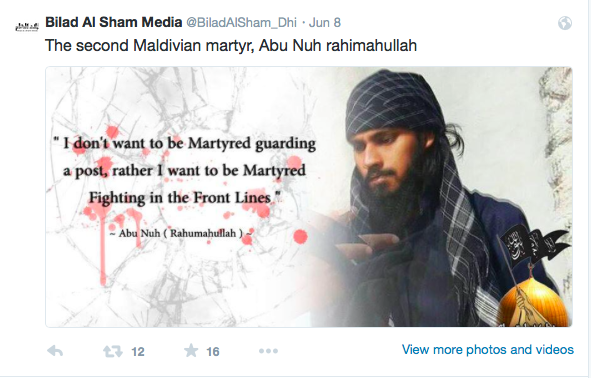
Figure 2 Abu Nuh, second Maldivian to die in Syria
Authorities differ greatly on the number of Maldivians who have travelled to join the war in Syria. The most recent police estimate put the figure at 50, while the Maldivian Democratic Party (MDP) puts the figure at around 200. While it is hard to get an accurate figure, judging from the number of reported deaths and the increasing numbers reported as leaving for Syria, the police estimate is ultra-conservative and, not unintentionally, misleading. The Maldives Police Service and the government have been largely6 unable or unwilling to address the issue. This is not surprising, given the links said to exist between the government, Islamists and law enforcement authorities7. At the UN Human Rights Council’s Universal Periodic Review in Geneva on 6 May 2015, Maldivian Foreign Minister Dunya Maumoon denied any Maldivian links to terrorism, and refrained from making any reference to the growing number of people leaving to Syria.
In contrast to the government’s reluctant admission to existence of limited extremism, the opposition has, for several years now, highlighted religious extremism as a major concern. Their figure of 200 fighters in Syria, however, appears inflated—at least for now. A more accurate figure would be somewhere in-between. From a population of just over 300,000 this is still a shockingly large number. There are more Maldivian fighters in Syria than there are from Afghanistan or many other countries in the Middle East8.
‘Hijra’ in large groups
In October 2014, Ahsan Ibrahim (23) left for Syria with his mother, wife and 11-year-old sister. They left their island Meedhoo, in Raa Atoll, on the pretext of seeking medical treatment in the capital Male’. Ali Ibrahim, father of Ahsan and the 11-year-old girl, only became aware of their plans a week later. In the five months since, Ali Ibrahim has only heard from his family once. ‘We are in Iraq’, Ahsan told his father in a phone call made on Viber. Ahsan told his father they have no intention of returning to the Maldives, which he described as ‘a land of sin’. They left it behind to be ‘on the right path’. With help from Maldivian authorities Ali Ibrahim confirmed his family has crossed the Turkish border into Syria, but he has no way of knowing whether his wife and children are dead or alive.9
Increasingly, Maldivians are leaving for Syria in large groups. This new trend can be spotted from early January 2015 onwards, when it was reported that a group of seven Maldivians had left together for Syria. It was also the first time connections emerged between dangerous criminal elements in society and those travelling to Syria. All seven members of the group belonged to a criminal gang. Among them was Azleef Rauf, a notorious gangster accused of involvement, among other violent crimes, in the murder of Dr Afrasheem Ali, an MP and a religious scholar known for relatively moderate views. The group entered Syria via the Turkish border. According to local media reports, Azleef planned to take his pregnant wife, one-year-old son and four-year-old daughter with him but was prevented by the wife’s family.10
Another group of six, en route to Syria to join with Azleef’s group, were stopped in Malaysia and returned to the Maldives on 12 January 2015. Their plans were reported to the police by a family member and four were stopped by a joint operation by Malaysian and Maldives police. Whereabouts of the other two are unknown, but they are believed to be in Indonesia11.
Another group of six Maldivians left for Syria on 29 January 2015. The group included the Imam of a mosque in capital Male’,